
A dangerous modern myth in today’s world is that “Happiness is an inside job”.
You may have bought the books, taken the workshops, written affirmations, put a smile on your face, posted Instagram photos of yourself on the beach in Hawaii, bathed in epsom salts, danced naked under the full moon and sauntered down to your local yoga studio with fierce determination – you know, done your homework.

Yet, you find yourself thinking, “there must be something wrong with me”, because you are still not truly happy. The experts say that all you have to do is choose to be happy, and that happiness comes from within. But at the end of the day, you are still sitting at home alone, eating a pint of ice cream in your gym clothes, and feeling like you are different than everyone else, because you still can’t find peace and happiness from within.
The good news is that you can stop feeling bad about yourself if none of these tricks have worked for you. Why? Because there is an overwhelming body of evidence that clearly indicates that Happiness Is Not An Inside Job.
The modern gurus proclaimed “You can be happy, no matter what, just like me!” I read the books, I took the workshops, I did the affirmations. Then, when I wasn’t happy, I felt bad about myself for not finding happiness from within. I thought there must be something wrong with me, because I couldn’t be happy all on my own. Eventually, my research led me to a larger truth.
Why Happiness Is Not Entirely An Inside Job
Okay, so we all know that happiness really is an inside job. Each of us has it within ourselves to choose to be happy, regardless of our environment and circumstances. However, the greater truth is that happiness is more than a state of mind attained through intellectual free will.
While there are numerous examples proving that within the realm of human experience, happiness can be completely an inside job, irrespective of environment and circumstance, these people are a statistically insignificant percentage of the human race. If you choose this path, to climb to the top of the mountain all alone, let me know when you get there, and please, share with me what tools you used along the way.
However, if you are going mad, struggling to survive all alone, in a sea of other people, all struggling to survive alone, believing that your happiness is purely dependent upon your own self, then understand this message:
You are more likely to find peace if you accept that happiness – your happiness, my happiness, anyone’s happiness – is also impacted by influences outside of one’s self.
Scientific research has shown that our happiness is influenced by our environment. The truth is that we live in an interdependent world. Humans are social creatures by nature. And for most of us, it is more difficult to be happy when we are cold, wet, hungry, sick and lonely, than when we have food, shelter, and human contact.
Scientific Studies
I. PRINCETON
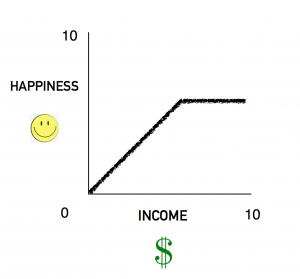
According to the internet, Princeton University conducted a study correlating income to happiness. They discovered that happiness increases with income, up to the point that a person can live comfortably, and not worry about their basic survival needs being met. After that, further increases in income do not correlate to further increases in happiness.
The point is that the external factors of having food and shelter, having your basic survival needs met, and being able to live in comfort, do indeed establish an environment that cultivates a greater sense of well-being.
Whereas the stress of struggling to meet your survival needs, or not being able to meet them, can make happiness less attainable. In other words, a sense of security and safety are fertile grounds for happiness.
II. HARVARD
 Harvard University conducted a 75-year study on what makes people happy. What they discovered is that the number one indicator of how happy a person is throughout their life is the quality of their loving relationships.
“Close relationships, more than money or fame, are what keep people happy throughout their lives, the study revealed.” This is a clear example that happiness is not purely an inside job, but rather is impacted by our external environment – how deeply we connect with other people. Watch the study Director Robert Waldinger’s Ted talk here.
III. RAT PARK

Researcher Bruce Alexander used to study rats in cages. Some studies were used to demonstrate the addictiveness of narcotics. Rats in certain situations would self-medicate heavily. Alexander noticed that these rats were always alone.
His team then built “Rat Park”, a village of rats, where they had food, sex and friends. They also had access to narcotics, but never abused them. The researchers suggested isolation may cause addiction, rather than drugs themselves. Thus, social interaction is an important component of happiness. This has led Johann Hari to suggest that “The opposite of addiction is not sobriety. The opposite of addiction is connection.” Watch his TED talk here.
Here again, we see how environmental factors can contribute to happiness, or lack thereof. While criticism of the rat experiments has arisen, the conclusion seems to stand valid. It appears that connection and quality relationships are significant contributors to happiness in life.
Connection And Happiness

Often, our connections are brief and surface-level, not intimate. If we are fortunate, we have human contact that goes deeper. These are the people we call our friends and loved ones, the people with whom we spend time. These are the nourishing relationships we need in order to be happy in life. You may wish to consider that what most people really want is meaningful connection. It is probably what you want, too.
What is connection? It is being seen. True connection is seeing the other, and being seen by the other. How deeply can you see someone? How deeply can you let someone see you?
According to some scholars, the desire to be seen is one of the greatest human desires. Not being seen is one of the greatest human pains. Author and speaker David Deida suggests that the greatest pain for the feminine essence of a being, or a feminine being, is to not be seen. And the greatest abuse to the feminine is to not see her.
Dale Carnegie, in his book How To Win Friends and Influence People, suggests that one of the greatest human desires after the basic needs for food, shelter and sex, is to have a feeling of importance. In other words, to be seen. When we are seen, we feel important. When we are not seen, we feel unimportant.
Someone skilled in positive self talk can tell themselves that they are important, whether or not they are being seen by others. However, the truth of the matter continues to remain, that for most people, our external environment does indeed play a factor in our internal state of being. An environment in which you are seen, in which you have a sense of importance, can contribute to your happiness.
Carnegie recounted instances of people who, in their sanity did not feel important, and were driven insane by their lack of importance. People go mad when they do not feel important, when they are not seen and heard. Without connection, humans go crazy.
You can continue to argue that happiness can be 100% an inside job. Without food, shelter or human contact, you can still be happy. But for the record, you are not likely to be so. The need to feel important, the need to be seen, are underlying needs that human connection fulfills, and they are as important as food and shelter, safety and security.
We can notice societal factors that separate us: economic and social structures, beliefs that divide us, cultures that we perceive as different than ours. We can point to trauma, war, rape, neglect, abuse, prejudice, violence, etc., that cause us to struggle to find peace, security, connection and happiness. We may wish to realize that we are all in this together, we all come from the same place, we are all going to the same place, we are all family, and what we all really want, for the most part, is to live in peace, prosperity and connection. We want food, shelter, sex and love. We want happiness, which is impacted not only by our choice of how to feel, but by the influences of the world upon us.
Allow Yourself To Be Human

If you want to achieve happiness purely from within, then climb to the top of the mountain alone, spend 20 years by yourself, sitting on your ass thinking about things while trying not to, and let me know how it works out for you. If this is your path, I encourage you to follow it.
For the rest of us, let us stop buying the story that “happiness is an inside job”. This is not an excuse to blame other people for your life. You still have it within you to choose your responses. You still need to own your personal power. Remember to love yourself as best you can. Find happiness from within as best you can. Know who you are and love yourself, enjoy your own company, be at peace alone and be fearless in your self-expression. You know, practice all these modern isolationist teachings on happiness.
Yet it may be unwise to aspire to such a lofty goal as to be truly happy and fulfilled, without human interaction, without connection, without food and without shelter.
I give you permission to be honest with yourself and the world, that you are a human being. Having your basic survival needs met, being physically safe, secure and well-fed, and enjoying nourishing social bonds are all aspects of your outer environment that have been proven to create more fertile ground for happiness, peace, growth, self expression, personal fulfillment and contribution to this world.
You do not have to buy into the madness that you must do this on your own. Acknowledge the scientific evidence that shows we need love, and question the “best-selling” rhetoric of isolated happiness. Seek to offer and receive connection. Seek to be, give and receive love.
Not to discourage you from climbing that mountain alone. For I encourage all beings to be fully self expressed. If that is your path, then how can I support you? If your desire is to utterly master life all alone, then go climb that mountain by yourself. Find happiness totally from within.
In which case, when I meet you on top of that cold, lonely mountain, I will share my snacks and tent with you, and we can keep each other good company.